
Worcester County Directory Collections
Worcester County historical directories are strongest when the publication year is part of the question. The Worcester Historical Museum provides the main discovery route for the historical run, including digitized and searchable volumes. Its collection begins with 1829, includes 1842 and 1843, covers most years from 1844 through 1870, and resumes for selected later years through 1945. The gaps matter. A missing result may reflect an unavailable volume, a spelling choice, or a change in how an address was printed. The Museum librarian is the right local fallback for a year not visible online.
| Collection | Years | Where Held | Access |
|---|---|---|---|
| Worcester City and Street Directories | 1829; 1842-43; most 1844-70; selected years to 1945 | Worcester Historical Museum Library | Digitized and searchable years online; ask staff about other volumes |
| Worcester Village Directory | 1829 finding aid | Worcester Historical Museum | Early city-area reference and collection lead |
| Directories and house directories | Local holdings vary | Worcester Public Library, third floor | Reference-desk and local-history assistance |
| Clipping file and local newspapers | About 1960-2015; NewsBank from 1989 | Worcester Public Library | Subject index and database access vary by title |
The table is a coverage map, not a claim of uninterrupted annual publication. Put the exact volume year, page, and spelling in a research note. That small habit makes a later comparison with a census, death record, or deed far more reliable.
Worcester County Directory Years Online
The Worcester Historical Museum directory collection is the direct online starting point for the listed digitized years. It describes names, addresses, occupations, businesses, spouse clues, street sections, and society material. Search the printed form of a name as well as a likely modern spelling. A firm may appear under its own name and again under one partner. A forwarding address can explain a disappearance from a street, but it does not prove a permanent move or death.
The digitized shelf is especially useful for setting the correct year before looking for a household. It also prevents a common mistake: treating a later address, copied from another source, as if it must appear in an earlier volume.
For an unlisted year, ask the Museum about its noncirculating library holdings. The library focuses on local and regional histories, directories, atlases, biographies, genealogies, serials, town records, military material, and family, business, and industrial papers. Research access is free with museum admission. Archival manuscripts, maps, and photographs are appointment-heavy, and the library lists Wednesday through Saturday, 10:00 a.m. to 4:00 p.m., at 30 Elm Street, Worcester, with 508-753-8278 ext. 105.
Worcester County Library History Shelf
The Worcester Public Library local-history guide broadens a historical-directory search when a volume alone leaves a question open. It identifies directories and house directories, Worcester Probate Court indexes from 1731 to 1897, census collections, Sanborn maps, Massachusetts vital-record microfilm, naturalization indexes, newspapers, passenger lists, and military material. The third-floor genealogy computers require access information from the reference desk. Local-history staff can also help identify whether a title is available only in the building.
WPL holds about 12,000 volumes in the Dr. John Green collection and early twentieth-century directories on the third floor. Its databases include American Ancestors, in-library Ancestry Library Edition, Fire Insurance Maps Online, NewsBank, and the New York Times. Remote access can differ from in-library access, so a failed home search is a reason to check with the reference desk rather than assume the source is absent.
Reading a Worcester County Directory Entry
Read an entry in parts. First capture the name exactly as printed, including initials and punctuation. Then note the occupation, address, household marker, and any business or office relationship. A spouse may appear in parentheses or italics. The printed entry is useful because those details were brought together for that publication year, but it still reflects the directory editor's choices and timing.
| Printed name | Keep the spelling, initials, and any partner or firm reference exactly as shown. |
|---|---|
| Occupation | Record the trade, business, or office wording without turning it into a current-status claim. |
| Street address | Capture number and street as printed, then compare it with a map or street-history source if needed. |
| Household clue | A spouse notation, post-office line, or forwarding address can connect volumes while remaining only a clue. |
| Section context | Note whether the entry sits in a personal, firm, street, business, church, or society section. |
- Criss-cross directory
- A directory arranged by street and address rather than by name. WPL describes house-directory holdings, but the exact coverage should be confirmed with staff.
- Householder index
- A name-oriented listing that points to a household or address in a particular publication year.
- Abbreviation key
- The volume's explanation of short forms. Check it before expanding a mark into a claim about a relationship or residence.
Worcester County Directory Marks
The directory collection identifies a small but valuable Worcester County quirk: h means home, r means residence, and b identifies a boarder who was not related to the household. Those marks can change how two people at the same address are interpreted. They do not identify every person present, and they should never be stretched into proof of a full household relationship.
Sample inventory: title, publication year, page, entry name, spelling variant, occupation, home or residence abbreviation, street number, spouse or household notation, firm, post-office or forwarding note, and nearby street or business section. Keeping all of those fields makes it possible to revisit the original rather than rely on a paraphrase.
Worcester County Directory Timeline
Worcester's record setting helps explain the directory shelf. The town was established in 1722, Worcester became the county seat in 1731, the Blackstone Canal arrived in 1828, and the railroad followed in 1835. The 1829 directory therefore sits near a major transition in the city's growth. Worcester became a city in 1848, and the long 1844-1870 directory run can be compared against that change without assuming every neighborhood had the same rate of development.
- 1829: Worcester Village Directory provides an early reference point.
- 1842-43: Two additional early volumes survive in the documented collection.
- 1844-1870: Most years in this long run are available through the historical directory collection.
- 1875-1945: Selected later volumes continue the documented shelf, with years including 1875, 1880, 1885, 1890, 1900, 1905, 1910, 1920, 1940, and 1945.
Worcester's City Clerk history also records a 1776 Declaration entry in permanent town records. That older municipal layer and the 1829 directory can meet in one family-history trail, but each record type answers a different question.
Tracing Worcester County Directory Households
Build a five-column note for Worcester County directory work: year, exact printed name, address, occupation or business, and confidence note. Begin with a likely volume, then move backward and forward. Pair directory years with the census years identified in the WPL guide, from 1790 through 1930. Vital records, probate, newspapers, cemeteries, churches, naturalization material, and land records can test a family connection without turning a printed listing into a conclusion.
- Find the earliest likely appearance and copy the entry exactly.
- Check the next available volume for the same name, street, occupation, firm, or spouse clue.
- Record an address change, but search a street-history source before treating it as a move.
- Pair the relevant directory period with a census year and compare household details.
- Use a newspaper, probate, cemetery, or vital-record source to test a disappearance or family link.
When an address shifts, WPL's street-history guide and Sanborn map resources can explain a renamed street, changed numbering, or altered building context. A forwarding address may be useful, but it remains a lead until another dated record supports it.
Worcester County Directory Follow-Up Sources
WPL's clipping file offers a later follow-up layer for a historical-directory question. It holds Telegram & Gazette and Evening Gazette clippings from roughly 1960 through 2015, with sparser earlier material, and uses a subject index. Local NewsBank articles are fully indexed from 1989 forward through library access. An obituary or article can name relatives, a former address, a church, a funeral home, or a cemetery, but each point still needs independent checking.
Probate indexes for Worcester Probate Court cover 1731 to 1897 in the WPL guide. Sanborn maps can add a building footprint, use, construction material, and neighborhood context. Neither tool is a resident list. They help explain the place around an entry and provide better terms for the next search.
Worcester County Cemetery Context
Hope Cemetery is a useful context source when a directory trail ends near a death, burial, or family plot question. Established in 1852, it replaced six earlier burial grounds and is a historic rural cemetery. Its grounds history gives background, but a cemetery reference should be tied to the requested lot, interment, or card record rather than treated as a complete online name search.
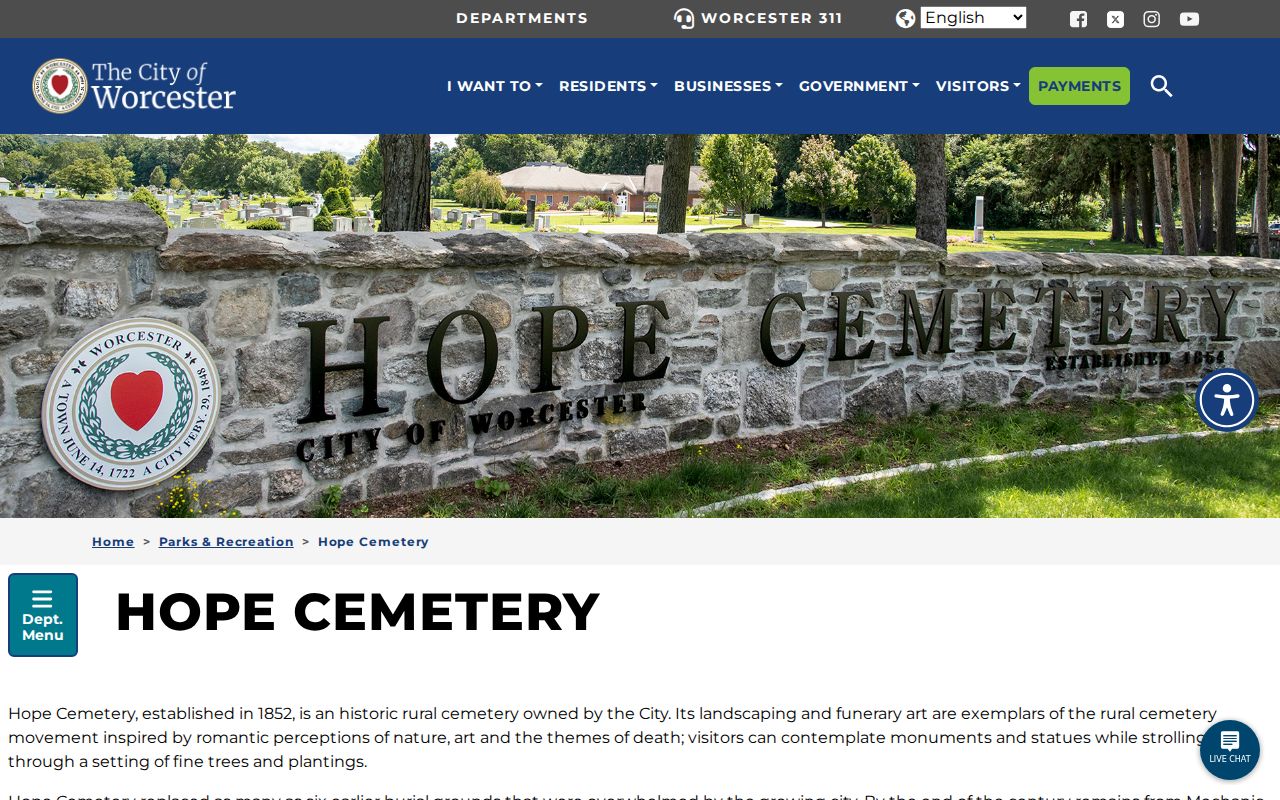
The cemetery is a companion source for a directory timeline, especially with obituary and probate research. A burial record may support an event date or family association, while the directory supplies a separate published address clue.
Worcester County Records Need Context
The Hope Cemetery database-management RFP shows why a neat search result should not be assumed. The 2026 proposal describes detailed records since 1888, including about 45,000 lot cards, 79,000 to 100,000 interment cards, maps, ledgers, slips, deeds, and burial certificates. It is a project description, not proof that a completed public database is available.
That distinction applies across historical work. A directory, a newspaper index, a cemetery card, and an official certificate can each be accurate within their own scope while describing different moments. Preserve the source, date, and exact field before comparing them.
Note: For a current identity question, use the relevant official custodian and confirm the result directly rather than relying on a historical directory listing.